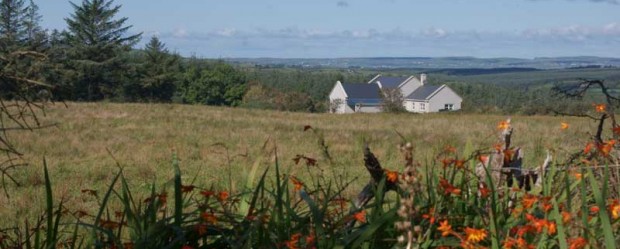
John came down with a terrible cold on Wednesday and spent most of the day in bed. On Thursday, the whole west coast was being buffeted by storm-force winds and torrential rain. Local school children were sent home due to an electricity blackout. We barely set foot out of doors and couldn’t, for a moment, imagine that any work would be done. On Friday, the sun came out again and we went to have another look at the site.
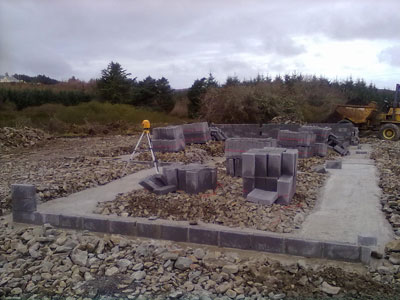 In fact, Pat’s men had turned up for work on Thursday morning, but there was little they could achieve. They laid out some corner blocks and went home. But, by mid-morning on Friday, the first layer of blocks had started to be laid around the outside walls of the new house and, at the far end, a double skin had been almost finished to floor level. We marveled at the speed of the work, until Marie explained that the men get paid per block!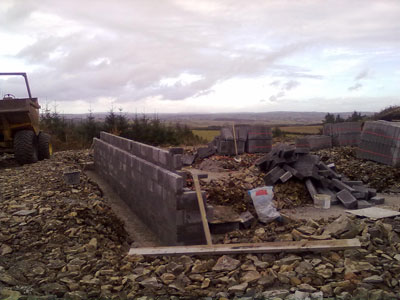
The concrete foundation had been laid in steps to take account of the stability and level of the rocky ground underneath. Remember that there was a 4′ 6″ fall between the old entrance gate and the chicken shed? In order to have level floors, it was necessary to compensate with three extra layers of blocks at the far end. In this picture, the top of the inside layer of blocks will be about 6″ below floor level by the time the foundations are filled with stone and a radon gas barrier and concrete skin added.
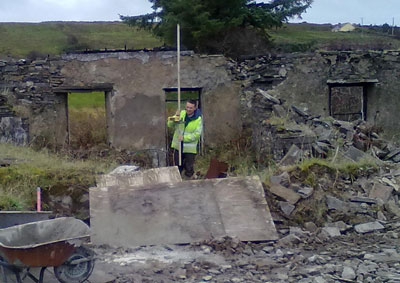
We were amazed at the apparent difference in height. It was difficult to see with the naked eye that the foundations would be level so, to reassure us a bit, Pat demonstrated with a laser theodolite. Then, just for fun, he showed us the difference in height against the original farmhouse. Look at where Pat is holding the laser pointer. That is where the floor level of the new house will be. 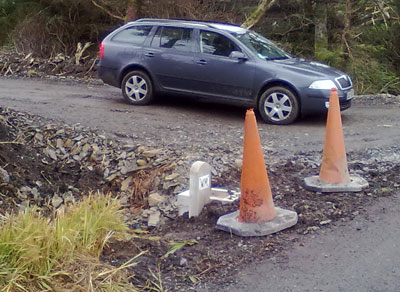
Pat’s men weren’t the only people that were busy over the last day or two. The Water Board had been to install our supply at the roadside.
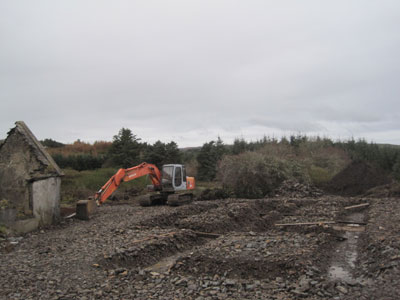 It had been raining heavily and there was no one around. However, it was evident that work was still progressing. The chicken shed had gone and the ground was dug ready for laying the foundations. We could now clearly see the outline and position of the new house. The footprint had been moved a few feet further away from the ruin, presumably to allow better access for vehicles.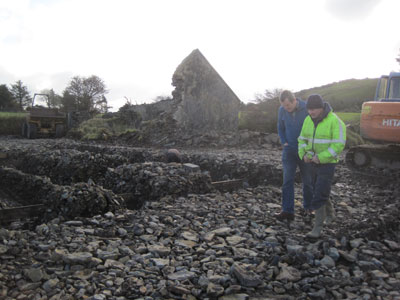
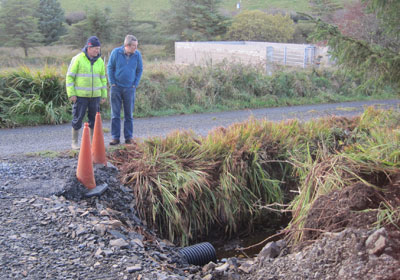 It was chilly, so we didn’t hang around and wait for the concrete. Pat needed to discuss the drainage at the road entrance. The Road Supervisor had initially asked for a pipe to be installed to allow rain water to drain freely into a ditch that runs along the perimeter of a neighbour’s field. Unfortunately, the heavy rain over the weekend demonstrated that a more sophisticated solution might be required.
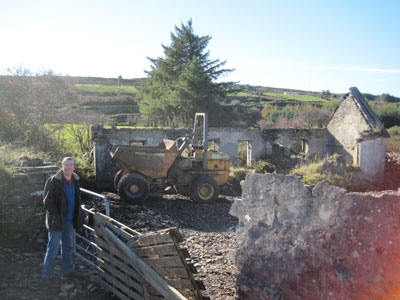 We had been to France and back with one load of furniture, dodging the fuel shortages, and had now arrived in Ireland with a 7.5 tonne truck containing the rest. In the meantime, Pat had been busy. The calf cabin and cart shed was now gone and the stones used to level up the site. The reek of turf from in front of the
 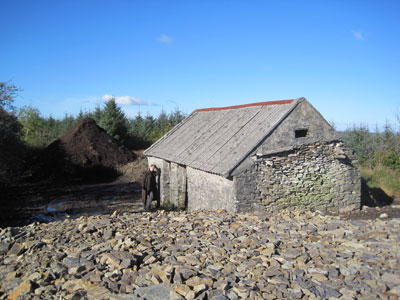 plot had also been moved and, with the rest of the useable topsoil, had been piled in a mountain behind the chicken shed. Now that the the grass, brambles and rushes had gone, it was easier to see the outline of the old house.
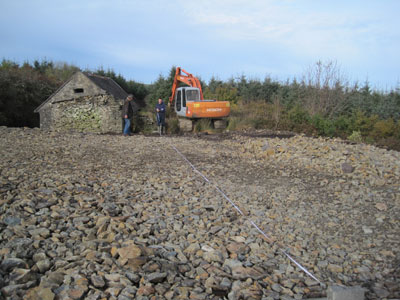 ped out the outline of our new bungalow. Look back at the previous entry on 13th October. It is hard to believe that this is the same site. And, when you look at the quantity of stone involved in leveling it, it is equally hard to believe that most came from just two buildings. We can truly say that the new house will be built on the foundations of the old one.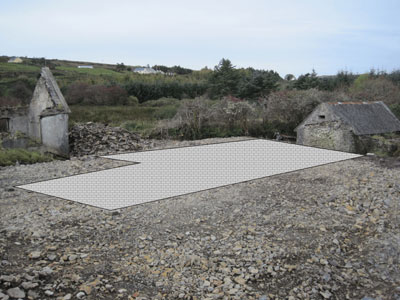
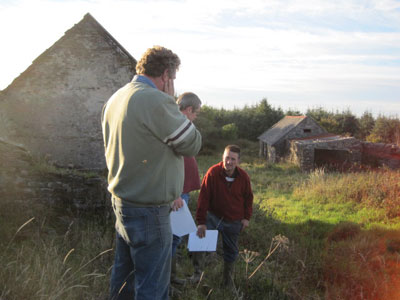 The other buildings in this picture are the old cart shed and chicken shed, the latter of which got nicknamed “Brigid’s folly” after I suggested that, being the only building with a roof, we might turn it into some sort of studio.
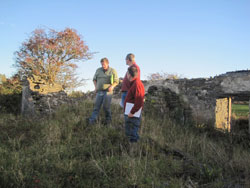 the three men standing on top of or inside the ruined front wall and you get an idea of the size of the old farmhouse. It was “tidy” by today’s standards.
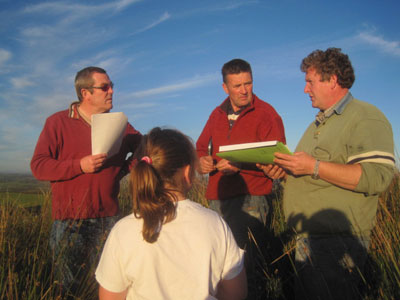 Land Registry map, it appeared that the boundary ran from the back wall of the calf cabin (not shown) to the far corner of the chicken shed. However, this was unlikely to be entirely accurate as the original map had been reduced to A4 and the boundary had been drawn by hand with a thick pen. For our purposes today, it would have to do.